I want to start with Christmas 1999.
Toys “R” Us had a website. It had products. It had customers who wanted to buy those products online, which in 1999 was still new enough to feel slightly magical — you could order a toy from your living room and it would arrive at your door, a genuine novelty that retailers were only beginning to understand.
What Toys “R” Us did not have was a working logistics system capable of handling the volume. The 1999 holiday season turned into a public catastrophe: orders placed in good faith, confirmed, paid for — and not delivered until after Christmas. Families had empty spaces under trees on December 25th where presents were supposed to be. The press coverage was brutal. The customer-trust damage was real and immediate.
That failure, in a way, is where the story truly begins — because it is the reason that Toys “R” Us, eight months later, signed the agreement that would define the rest of its existence.
The store that felt like its own world
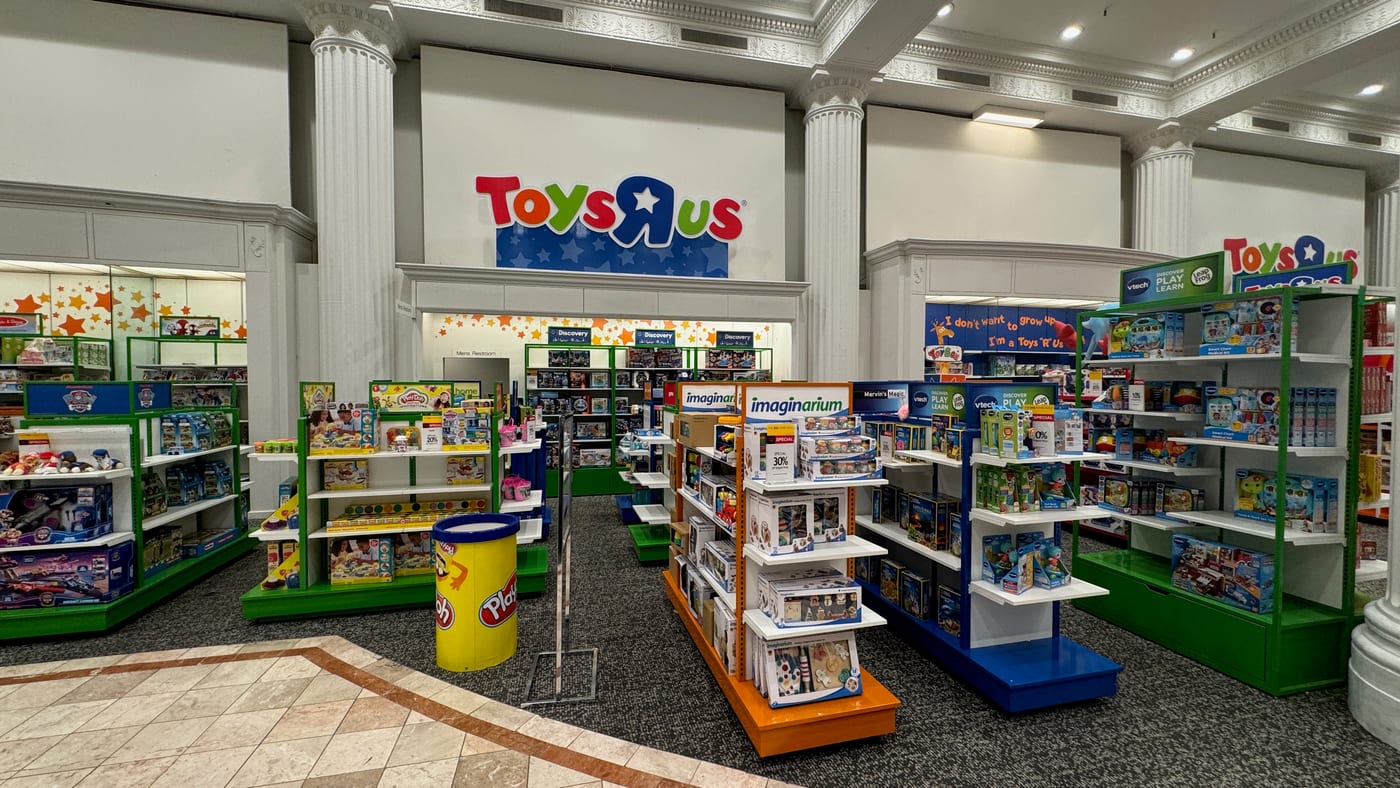
Before any of this, you have to hold in your mind what Toys “R” Us actually was, because the financial story only lands fully if you remember what it felt like to be inside one of those stores as a child.
It was not a toy section. It was not a toy aisle. It was an entire building dedicated to the proposition that children deserved a space designed entirely around them. The ceilings were high. The aisles went on longer than seemed architecturally necessary. There were sections for action figures, sections for board games, sections for bikes you could not ride inside but desperately wanted to. Geoffrey the Giraffe smiled from every surface.
Going to Toys “R” Us was an event. Parents understood this and deployed it strategically — as reward, as bribe, as birthday ritual. The store had the specific gravity of a place that children believed was built for them personally. Very few retail concepts in history have managed that.
At its peak, Toys “R” Us operated more than 1,500 stores worldwide, including 681 in the United States. It was not merely the largest toy retailer in the world. It was the category. Toymakers organised their entire production and distribution calendars around its shelf space. Hasbro and Mattel needed it more than it needed them, and everyone in the industry understood that.
That kind of power is both a business asset and a psychological trap. It creates a certainty about your own indispensability that is very difficult to dislodge — even when the evidence is accumulating, one failed Christmas at a time, that something fundamental is shifting.
The contract
In August 2000, Toys “R” Us signed a ten-year agreement with Amazon. Toys “R” Us would pay Amazon $50 million every year, plus a percentage of sales. In exchange, it would be the exclusive seller of toys, games, and baby products on Amazon through 2010. On the day the deal was signed, Toys “R” Us shut down its own website and redirected all traffic to Amazon.
Read that sentence again.
A company with 1,500 stores and one of the most recognisable brand names in retail handed its entire online presence — its URL, its customer traffic, its digital future — to a partner and stopped operating independently on the internet. It was hailed at the time as a model for how traditional retailers could thrive alongside e-commerce giants. It was the single most consequential decision the company ever made — and it contained a problem that would not become visible for three years.
What the contract actually said — and what Amazon actually did
The agreement gave Toys “R” Us what it believed were exclusive rights. What it did not adequately anticipate was Amazon’s interpretation of the word “exclusive.” By 2003, Amazon had begun inviting other toy brands — Hasbro, Mattel, and thousands of third-party sellers — onto the platform. By May 2004, more than 4,000 products in categories Toys “R” Us believed it owned exclusively were being offered by competitors on Amazon. Toys “R” Us had paid $200 million over four years for a right that was being violated in real time.
Toys “R” Us sued. In the 2006 trial, New Jersey Superior Court Judge Margaret Mary McVeigh delivered a 131-page ruling against Amazon — and used language about its leadership that does not appear often in judicial opinions. Of Jeff Bezos’s testimony, she wrote that she had “no doubt his knowledge and understanding of the agreement went much deeper than revealed.” One of his explanations she described, in the ruling, as “rather childlike.”
— New Jersey Superior Court, Judge Margaret Mary McVeigh, March 2006
Toys “R” Us won. Amazon was found to have breached the agreement, the partnership was severed, and Amazon eventually paid a $51 million settlement. And none of it mattered in the slightest.
Toys “R” Us won the lawsuit. It lost the decade. Those are not the same thing.
What Amazon learned while nobody was watching
This is the part the verdict buries, because winning in court feels like a conclusion when it is actually a footnote.
Between 2000 and 2006, Amazon had a front-row seat to the entire toy retail business. It could see exactly which products were selling, when, and at what prices. It could see which categories had margin, which had velocity, which had seasonal spikes. It could see the customer data — who was buying, what, and how often. For six years. For $50 million a year — paid by Toys “R” Us.
What six years of not building actually costs
Between 2000 and 2006, Amazon grew from a promising online bookseller into the infrastructure of American retail. It built Prime. It built fulfilment centres across the country. It built the recommendation engine, the review system, one-click checkout — and the expectation, in a generation of shoppers, that buying online should be frictionless and fast. By the time Toys “R” Us launched its own site in 2006, those expectations were already formed, and it was launching against them without the years of iteration that forming them had required. The gap was not technical. It was temporal. You cannot buy back the years you did not spend building.
The millennial parents who were Toys “R” Us’s prime demographic had, in exactly this window, become Amazon Prime members. When they had children and needed toys, the habit was already formed. It did not point toward a store.
The second trap
Here is where the story becomes genuinely grim — because even if Toys “R” Us had navigated the Amazon deal perfectly, it would still have faced what happened in 2005. KKR, Bain Capital, and Vornado Realty Trust acquired the company in a leveraged buyout for $6.6 billion.
The mechanics of a leveraged buyout, in simple terms: a private equity group buys a company using mostly borrowed money, loads that debt onto the company itself, and then attempts to generate enough operational improvement to service the debt and eventually sell at a profit. When it works, it can create real value. When it does not, the debt becomes an anchor that drags the company down regardless of what its managers do.
For Toys “R” Us, it did not work. The company spent the next twelve years paying $400 million a year in debt service on more than $5 billion in obligations — money that could not renovate stores, build a digital platform, or fund the sustained investment in customer experience that might have competed with Walmart or Amazon. The CEO who filed for bankruptcy in 2017 said it plainly in court: “These substantial debt service obligations impair the company’s ability to invest in its business and future. As a result, the company has fallen behind.” The three firms eventually wrote their $3.5 billion of invested capital down to zero.
What actually happened
There is a version of this story where Amazon is the villain and the moral is about disruption. That version is easier to tell. It is also mostly wrong.
Amazon was a competitor. Walmart was a competitor. The internet was a shift every physical retailer had to navigate — and Target navigated it, Best Buy navigated it. What was unique to Toys “R” Us was the sequence: a disastrous Christmas that forced a panic decision, a partnership that handed a competitor six years of education, a lawsuit victory that changed nothing operationally, and then a leveraged buyout that loaded the company with debt precisely when it most needed flexibility to adapt.
Each decision, in its own moment, was defensible. Together, in sequence, they left a company with no digital capability, no capital to build one, and $400 million a year in obligations that made even incremental investment nearly impossible.
Toys “R” Us closed not because toys stopped mattering. It closed because the company had signed away its future, one defensible decision at a time.
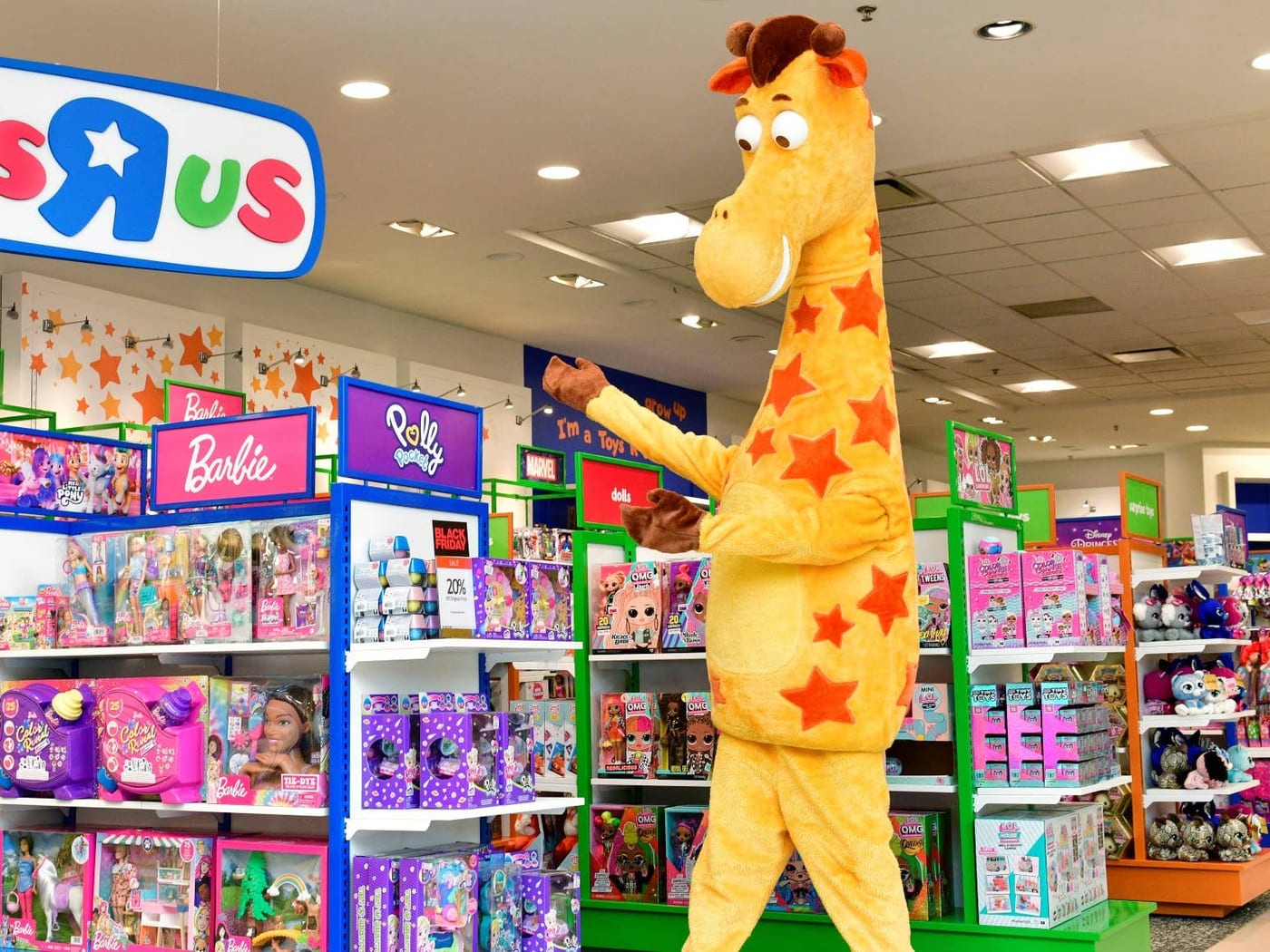
The brand has since been revived in a limited form — a few stores, partnerships with Macy’s, a presence in airport shops. Geoffrey the Giraffe still appears on merchandise. The name still carries enough memory that it can be licensed for a retail experience that is, by most accounts, a pale echo of what the original was.
 MINI!
MINI! The original was something different. It solved a genuine problem — where do you go when you want to browse, to compare, to hold the toy and imagine owning it, to let the choice form slowly in a room full of possibility? It was, at its best, not just a store but a ritual.
That ritual is gone. Not because it stopped working, but because the company that housed it ran out of money to keep the lights on. And the reason it ran out of money is sitting in a New Jersey court filing from 2006 — a 131-page ruling where a judge described the testimony of the world’s most powerful retailer as “rather childlike,” and found it had taken $200 million from a company that trusted it, while building, quietly and systematically, everything it needed to make that company unnecessary.
Frequently asked
Did Toys “R” Us actually win its lawsuit against Amazon?
Yes. In March 2006, New Jersey Superior Court Judge Margaret Mary McVeigh ruled that Amazon had breached the exclusivity agreement, and was notably critical of Jeff Bezos's testimony — describing one explanation as “rather childlike.” Amazon later settled for $51 million. The ruling let the companies part ways but awarded no trial-level damages.
What was the leveraged buyout, and why did it matter so much?
In 2005, KKR, Bain Capital, and Vornado Realty Trust bought Toys “R” Us for $6.6 billion in a leveraged buyout — financed largely with debt loaded onto the company. Toys “R” Us then spent roughly $400 million a year servicing more than $5 billion in debt, money that couldn't be reinvested in stores or technology. The firms eventually wrote their investment down to zero.
Is the Toys “R” Us brand still alive?
In a limited form. The brand was acquired after bankruptcy and revived through small-format stores, a partnership with Macy's, and licensing. Geoffrey the Giraffe remains an active mascot, but the original large-format destination store has not been meaningfully rebuilt.