I want to start with a man named Frank Nuovo.
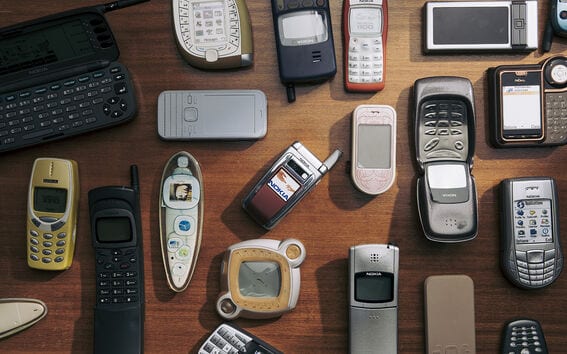
Nuovo was Nokia’s chief designer through its greatest years — the person most responsible for the physical language of a product that, in the late 1990s and early 2000s, was in more pockets than any other object on earth. Nokia phones were not merely functional. They were designed. The 3310 had a specific weight to it, a satisfying click on the keypad, a kind of solidity that made it feel like it would survive being thrown across a room. It probably would have. Nuovo was the reason for that feeling.
By 2002, Nuovo’s team had built a prototype that looked, functioned, and behaved almost exactly like what Steve Jobs would present to the world five years later. A touchscreen. A single button below it. You could use it to browse the internet, find a restaurant, play a game. The concept was complete. The hardware existed. The vision was real.
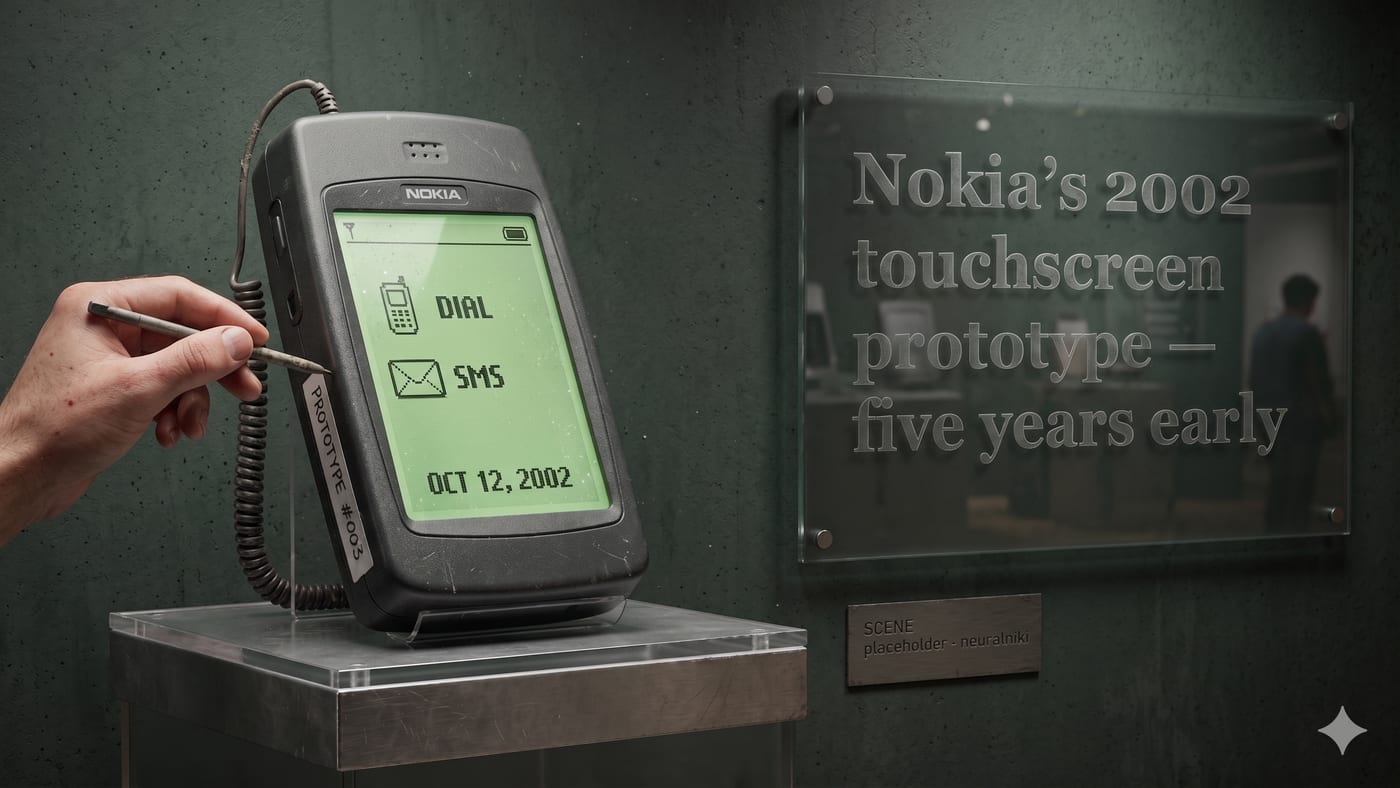
Nokia looked at it, and decided not to build it.
“We had it completely nailed. I was heartbroken when Apple got the jump on this concept.” — Frank Nuovo
That sentence sits there like something you are not supposed to think too hard about. Nokia had it completely nailed. Five years before the iPhone. And somehow the iPhone happened anyway. The reason is not the one most people assume.
The company that remade itself three times
Before Nokia was a phone company, it was a paper mill. Before that, a rubber manufacturer. The company started on the banks of the Nokia river in Finland in 1865, making pulp. Over the next century it stumbled through tyres, cables, and televisions before arriving, almost accidentally, at mobile communications in the 1980s — and discovering it was extraordinarily good at it.

The Nokia 9000 Communicator launched in 1996. It had a full keyboard, a web browser, an email client, and a fax function. It was described as the first real smartphone, predating BlackBerry and Palm by years. CEO Jorma Ollila told the Financial Times that August they were shipping every Communicator they could make. Bill Gates visited a Las Vegas tech conference specifically to get a demo of it. Microsoft reportedly bought a number of units just to study it.
For the next eleven years, Nokia would hold more than 40% of the global mobile phone market — the highest concentration any handset maker has ever achieved. At the end of 2007, after the iPhone had been on sale for five months, Nokia’s global market share was still 40.4%. The company was shipping hundreds of millions of phones a year.
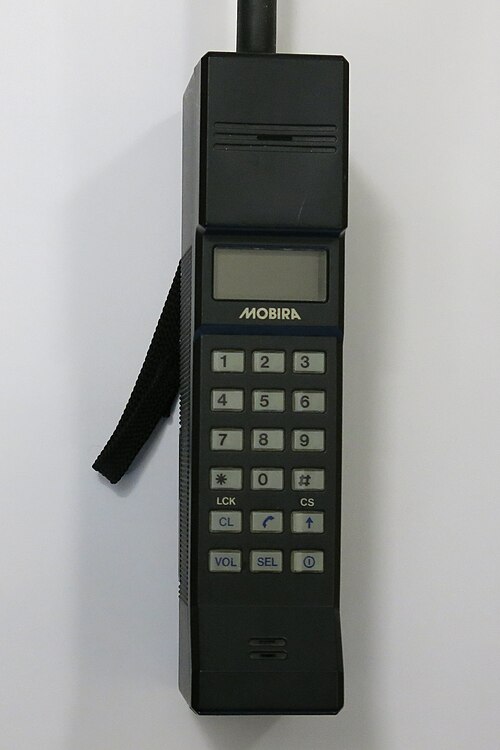 Mobira Cityman, 1980s
  Karaportti HQ, Espoo
 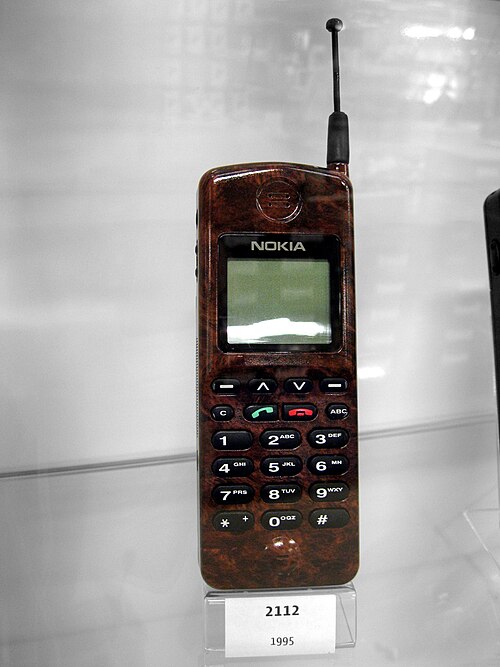 Nokia 2112
 That collapse — from 40% to 3.5% in five years — is one of the fastest destructions of market dominance in the history of consumer technology. And almost nobody inside Nokia could explain how it happened, because almost nobody inside Nokia had been told the truth about the forces building against them.
The study that explained everything
Between 2012 and 2014, two professors — Timo Vuori of Aalto University in Finland and Quy Huy of INSEAD in Singapore — conducted one of the most unusual pieces of corporate research ever published. They interviewed 76 people: Nokia’s top managers, middle managers, engineers, and external experts, many speaking under the protection of anonymity for the first time. They wanted to understand not just what had happened, but how it had felt from the inside.
What they found was not complacency. It was not technical failure. It was not that Nokia’s leaders had looked at the iPhone and decided it wasn’t a threat. It was fear. Systematic, structural, contagious fear — running simultaneously in two opposite directions through the same organisation.
What the 76 interviews revealed
Middle managers at Nokia, the researchers found, were deeply afraid of their superiors, who had a widely understood reputation for impatience with anyone delivering unwelcome information. Budgets were cut. Careers stalled. Resources were redirected toward people who reported progress and away from those who reported problems.
So the information flowing upward was edited — not through any single conspiracy, but through thousands of individual calculations made by people who knew, from experience, what kind of news was safe to deliver. Engineers who knew the software wasn’t ready said it was nearly ready. Managers who understood Symbian was falling behind told their superiors it would be competitive within eighteen months. Nobody lied exactly. Everyone softened.
At the same time, top management was afraid too — but outward, at competitors and investors. They knew Symbian was struggling, and were afraid to admit it publicly for fear of triggering a collapse in supplier and investor confidence. “It takes years to make a new operating system,” one top manager told the researchers. “That’s why we had to keep the faith with Symbian.” They could not say it was broken. So they kept saying it was fixable.
— Vuori & Huy, “Distributed Attention and Shared Emotions in the Innovation Process,” 2016
The result was a company in which everyone, at every level, was making decisions based on a version of reality that had been cleaned up for someone else’s benefit. The engineers knew. The middle managers knew. The top managers, in their own way, knew. But the knowing never collected into action, because the act of saying it out loud, clearly, to the right person, felt like career suicide.
Nokia was not undone by a failure of intelligence. It was undone by a failure of safety — the psychological kind.
January 9, 2007
Steve Jobs walked onto a stage in San Francisco and announced that Apple was reinventing the phone.
Inside Nokia, a detailed internal presentation was circulated within days. It has since become public, and it is remarkable not for what it gets wrong but for what it gets exactly right: the iPhone’s multi-touch interface would redefine user-experience standards across the industry; its cultural appeal would be difficult to counter on technical grounds alone; its pricing would reshape the premium market. The presentation was lucid, accurate, and alarmed.
It also noted that the iPhone lacked 3G, had limited app support, and came with a non-removable battery. Nokia’s strategic response included accelerating its own touch development, undercutting Apple on price in the mid-range, and emphasising the technical superiority of its hardware. Every one of those assessments was correct on its own terms. Every one of them missed the point.
The thing Nokia’s internal presentation could not say
What no document circulating inside Nokia in January 2007 could safely state was this: the company’s operating system, Symbian, was not competitive with what Apple had built; a replacement would take years Nokia did not have; and the culture that might have built something better had been systematically discouraged from saying so. The iPhone was not primarily a hardware problem. It was a software and culture problem — the two things Nokia’s internal communication system was least equipped to address honestly.
A partner who worked closely with Nokia during this period later described it with a precision that is hard to improve on. “What struck me was how Nokia spent much more time than other device makers just strategising. We would present Nokia with a new technology that seemed like a huge opportunity. Instead of just diving in, Nokia would spend six to nine months assessing it. And by that time, the opportunity was gone.”
Six to nine months. For each decision. In an industry where Apple was moving in weeks.
The part that makes it genuinely sad
Nokia’s engineers were not passive. They were not complacent. They were, by most accounts, brilliant — and they had been building toward the right answer for years. The 9000 Communicator in 1996. The touchscreen prototype in 2002. A tablet concept in the late 1990s, years before the iPad. Nokia outspent Apple on research and development for much of this period. The talent was there. The ideas were there. What was not there was a path from “we built this” to “we shipped this” that did not require navigating a management culture that punished the bearer of uncomfortable information.
Frank Nuovo left Nokia in 2006, a year before the iPhone launched. In 2011, Nokia announced it would abandon Symbian and bet everything on Microsoft’s Windows Phone — a partnership with a company whose own mobile strategy was years behind the market. It was the kind of desperate, all-or-nothing move companies make when they have run out of internal options. The bet failed. In 2013, Microsoft acquired Nokia’s mobile business for $7.2 billion. Two years later, it wrote down nearly the entire value of the acquisition.
The company that had launched the first real smartphone in 1996 ended its phone business as a footnote inside a software company that also failed to make it work.
What it actually teaches
The Nokia story gets told, most often, as a lesson about disruption — the clean incumbent-misses-the-wave narrative business schools love because it implies the solution is simply to be more like Apple. That is the wrong lesson.
Nokia was not slow because it lacked vision. It was slow because the cost of being honest inside the organisation had become higher than the cost of being wrong. When that happens — when the people who know the most have the strongest incentive to say the least — a company does not need a competitor to destroy it. It does it quietly, from the inside, one softened status update at a time.
The 76 interviews revealed something that should be uncomfortable for anyone who has worked in a large organisation: Nokia’s middle managers understood the problem clearly. They saw the iPhone threat accurately. They knew Symbian was not the answer. And they said nothing useful — not because they were cowards, but because their environment had taught them, through repeated experience, that clarity was dangerous and softness was safe.
That is not a technology problem. That is a human problem. And it is not unique to Nokia.
The prototype that became the iPhone was sitting in a Nokia lab in 2002. “We had it completely nailed,” said the man who built it. Then the company that employed him decided the truth was too expensive — and spent the next eleven years paying the much larger price of not hearing it.
Frequently asked
Did Nokia really build a touchscreen smartphone before Apple?
Yes, on multiple occasions. The Nokia 9000 Communicator (1996) was widely considered the first real smartphone, and chief designer Frank Nuovo has confirmed a touchscreen, internet-connected prototype functionally similar to the iPhone existed by 2002 — five years before Apple's launch. None reached market in that form.
What was the INSEAD study and why does it matter?
Professors Timo Vuori and Quy Huy interviewed 76 Nokia insiders between 2012 and 2014 and published their findings in 2016. It remains one of the most detailed inside accounts of how a culture of fear systematically blocked the flow of accurate information in a major corporation — and is now taught as a case study in organisational psychology, not just strategy.
What happened to Nokia after the Microsoft sale?
Microsoft acquired Nokia's phone business for $7.2 billion and wrote down nearly the entire value within two years. Nokia itself continued as a networking-equipment company and patent holder, which it remains today. The brand was later licensed to HMD Global for Android phones — a company with no meaningful connection to the original Nokia organisation.